

Corneal Crosslinking/CXL
Corneal Crosslinking/CXL for Keratoconus Surgery in West Springfield, MA
What is Keratoconus?
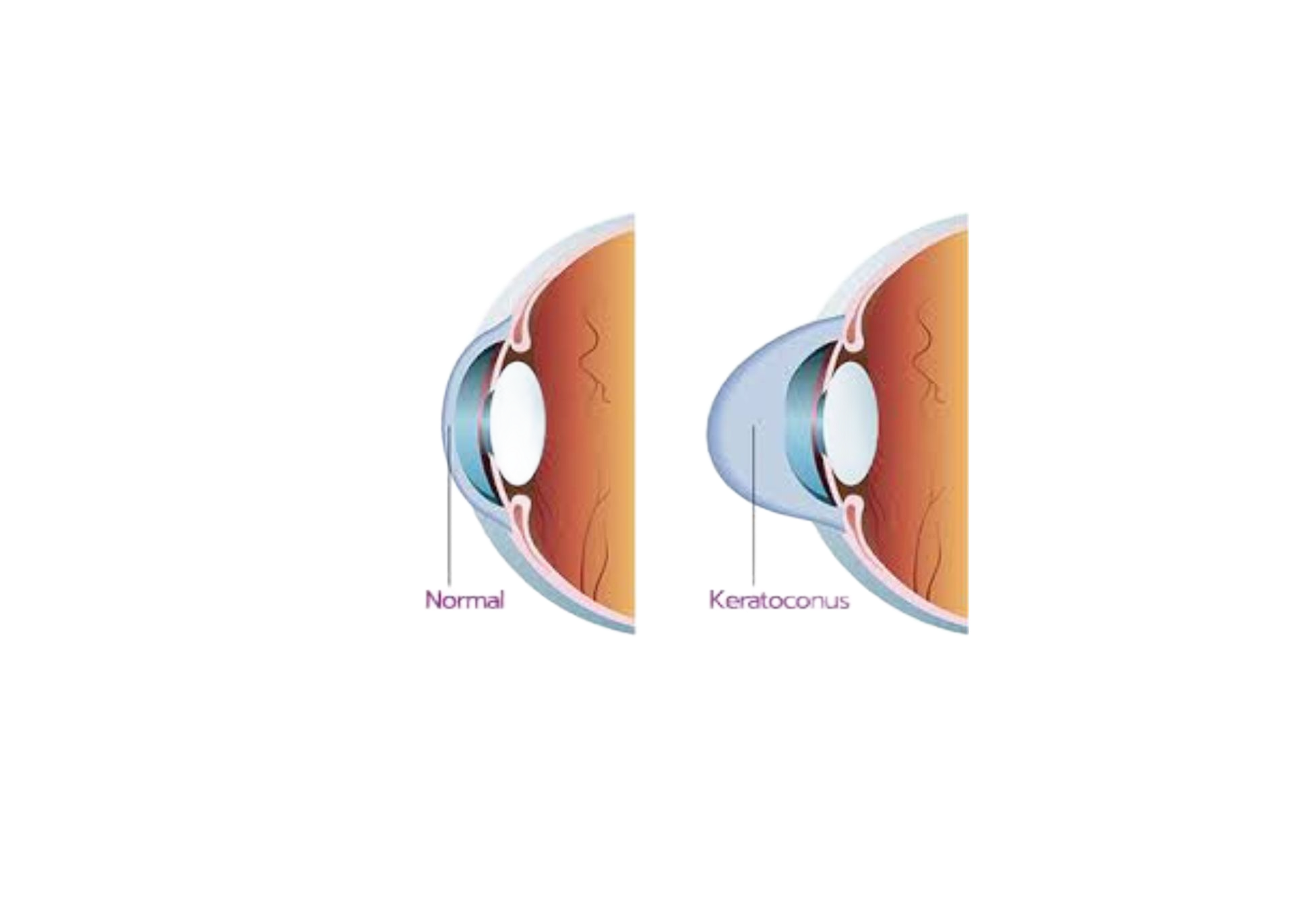
Keratoconus is an ocular disease that affects the cornea, the "outer window" of the eye (most notable as the surface upon which contact lenses rest). Keratoconus is a painless, irreversible and progressive bilateral disease that usually begins in the second or third decade of life but may manifest in patients older than 40.
There are many apparent causes of the disease, but all result in the cornea losing its regular "dome-like" shape (envision a cereal bowl being placed upside down on a table) and becoming warped. As the cornea is the eye's primary light bending (refractive) element, warpage of the cornea seriously affects vision. Attempting to visualize objects through a warped cornea is like trying to view images through a shattered, but intact, window - some aspects of an object are clear, while other aspects are not recognizable. This visual distortion is caused by light rays being refracted in an irregular pattern, making focusing impossible. Until the FDA approval of collagen cross linking in 2016, there was no known treatment that stops the progression of keratoconus. Indeed, until cross linking, all that could be offered were continual strengthening of glasses/hard contact lenses until the warpage became so severe that cornea transplantation (replacing the center, most distorted, part of the cornea) was the lone remaining alternative to address the optical distortion and scarring related to advanced keratoconus.
What is Corneal Crosslinking/CXL?
Collagen cross linking involves using riboflavin (Vitamin B2) and ultraviolet light to create chemical bonds between corneal proteins to increase the strength of the cornea and resist warpage. Indeed, by 2022, the use of cross linking decreased the need for cornea transplantation in keratoconic patients by more than 25%. The initial iteration of cross linking required the removal of the superficial cells of the cornea to allow adequate absorption of the riboflavin and oxygen during treatment ("epithelium or epi-off"). While effective, some patients experienced irritation and a recovery period of one week. In October 2025, the FDA approved a new collagen cross linking iteration called "epi-on" treatment which typically results in a quicker, more comfortable experience for the patient. We are honored to be among the first practices in the United States to offer this technologic advance to patients in Western New England.
Click Here to Get In Touch With Us
Hours:
Mon
8:30 - 5:00
Tues
8:30 - 5:00
Wed
8:30 - 5:00
Thurs
8:30 - 5:00
Fri
8:30 - 5:00
Sat/Sun
Closed
Book An Appointment
Keratoconus
Keratoconus Treatment with Intacs in Springfield
Keratoconus is a disease that causes a progressive thinning of the cornea, the clear front portion of the eye. As a result of this condition, the normal outward pressure from within the eye causes the cornea to progressively bulge into a cone-like shape. Keratoconus rarely results in total blindness although it can significantly impair vision and, according to experts, lead to the need for a corneal transplant in up to 20% of cases.
While nobody knows the cause of keratoconus, there is evidence that the disease has genetic origins, possibly made worse by environmental factors. It normally affects both eyes, though it typically progresses at different rates. In most people, keratoconus begins during their teen years and slowly worsens before stabilizing in their 30’s or 40’s.
Keratoconus is estimated to affect one in 2,000 people across all races. It is normally treated with rigid contact lenses to reshape and flatten the pronounced curve of the bulging cornea and to improve vision. A proper contact lens fit is crucial to obtain adequate vision and wearing comfort. Poorly fitting or outdated contact lenses can be uncomfortable and lead to additional complications like corneal abrasions, scarring or infection.
A Closer look at Intacs
Intacs prescription inserts provide a unique new option to improve a patient’s vision and possibly defer a corneal transplant. Intacs are indicated for the correction of nearsightedness and astigmatism for patients with keratoconus, where contact lenses and glasses no longer provide suitable vision.
For those keratoconic patients who are contact lens intolerant, Intacs prescription inserts offer a less threatening option than a corneal transplant. Most physicians would prefer to delay a corneal transplant to make it the option of last resort. Intacs prescription inserts make this a possibility by improving functional vision, and possibly delaying the need for a corneal transplant.
Placing Intacs in the periphery of the cornea flattens the center by restoring the natural dome shape of the cornea to improve vision.
Imagine your keratoconic cornea as a tent with a curved top. If the sides are pushed out, the top is flattened slightly and the dome shape is restored.
The goal of the Intacs procedure is to provide the keratoconic patient with the ability to achieve improved functional vision with contact lenses or glasses and in some cases without them. In the few patients who later had a corneal transplant after having the Intacs procedure, their transplants were completed without any complications. Call Dr. John Frangie at (413) 363-2732 to see if Intacs are right for you.
Frequently Asked Questions:
Will insurance cover this procedue?
Insurance companies may cover all aspects of the procedure for keratoconus. Since this is a new indication, some insurers may not yet recognize this procedure for treating keratoconus. Addition Technology is working to educate insurers on the importance of the Intacs procedure for treating keratoconic patients. You and your doctor may, in some cases, also need to help educate your insurance company. For more information and assistance, please visit our website at WWW.INTACSFORKERATOCONUS.COM.
Where can I get more information?
For more information about Intacs treatment for Keratoconus in West Springfield, MA, call our office today at 413.363.2732 or Fill Out our ONLINE FORM.
* As with any surgical procedure, there are some risks, including infection. Some patients experience visual symptoms including difficulty with night vision, glare, halos, blurry and fluctuating vision.
** Humanitarian Device: Authorized by U.S. Federal law for use in the treatment of nearsightedness and astigmatism associated with keratoconus. The effectiveness of this device for this use has not been demonstrated.
Click Here to Get In Touch With Us
Hours:
Mon
8:30 - 5:00
Tues
8:30 - 5:00
Wed
8:30 - 5:00
Thurs
8:30 - 5:00
Fri
8:30 - 5:00
Sat/Sun
Closed
Book An Appointment
When you’re ready to take the next step towards safe and permanent vision correction, call our office at 413.363.2732 or fill out our contact form and we’ll schedule a free consultation for No Blade LASIK in West Springfield, MA.