

Corneal Crosslinking/CXL
Corneal Crosslinking/CXL for Keratoconus Surgery in West Springfield, MA
What is Keratoconus?
Keratoconus is an ocular disease that affects the cornea, the "outer window" of the eye (most notable as the surface upon which contact lenses rest). Keratoconus is a painless, irreversible and progressive bilateral disease that usually begins in the second or third decade of life but may manifest in patients older than 40.
There are many apparent causes of the disease, but all result in the cornea losing its regular "dome-like" shape (envision a cereal bowl being placed upside down on a table) and becoming warped. As the cornea is the eye's primary light bending (refractive) element, warpage of the cornea seriously affects vision. Attempting to visualize objects through a warped cornea is like trying to view images through a shattered, but intact, window - some aspects of an object are clear, while other aspects are not recognizable. This visual distortion is caused by light rays being refracted in an irregular pattern, making focusing impossible. Until the FDA approval of collagen cross linking in 2016, there was no known treatment that stops the progression of keratoconus. Indeed, until cross linking, all that could be offered were continual strengthening of glasses/hard contact lenses until the warpage became so severe that cornea transplantation (replacing the center, most distorted, part of the cornea) was the lone remaining alternative to address the optical distortion and scarring related to advanced keratoconus.

What is Corneal Crosslinking/CXL?
Collagen cross linking involves using riboflavin (Vitamin B2) and ultraviolet light to create chemical bonds between corneal proteins to increase the strength of the cornea and resist warpage. Indeed, by 2022, the use of cross linking decreased the need for cornea transplantation in keratoconic patients by more than 25%. The initial iteration of cross linking required the removal of the superficial cells of the cornea to allow adequate absorption of the riboflavin and oxygen during treatment ("epithelium or epi-off"). While effective, some patients experienced irritation and a recovery period of one week. In October 2025, the FDA approved a new collagen cross linking iteration called "epi-on" treatment which typically results in a quicker, more comfortable experience for the patient. We are honored to be among the first practices in the United States to offer this technologic advance to patients in Western New England.
Click Here to Get In Touch With Us
Hours:
Mon
8:30 - 5:00
Tues
8:30 - 5:00
Wed
8:30 - 5:00
Thurs
8:30 - 5:00
Fri
8:30 - 5:00
Sat/Sun
Closed
Book An Appointment
Cornea Transplants/DSEK
DSEK Corneal Transplant Surgery in Springfield, MA
What is a corneal transplant?
What is a corneal transplant, and how is the DSEK procedure performed? Learn the answers to these important questions and read all about the DSEK corneal transplant surgery right here.
Your cornea may become damaged via direct trauma, or via degenerative disease. In this case, vision may be impaired, and there may be pain and other symptoms as well.
So what is a corneal transplant? Well, as the word “transplant” implies, during corneal transplant surgery your damaged cornea will be replaced with a undamaged, clear cornea from a donor.
However, with the DSEK procedure, or Descemet Stripping Endothelial Keratoplasty, the full cornea is not actually replaced. Instead, only some of the posterior or inner layers of the cornea are replaced with healthy tissue.
DSEK corneal transplant surgery is a newer technique, and it’s also a complex procedure, requiring a skilled cornea specialist to successfully and safely perform.
Benefits to DSEK corneal transplant surgery
There are many benefits to DSEK corneal transplant surgery, including:
- A smaller wound with fewer, or no, stitches
- Quicker healing and full vision in just three to six months, compared to one year
- Chances of infection or irritation are reduced, as is susceptibility to other injuries or rupturing
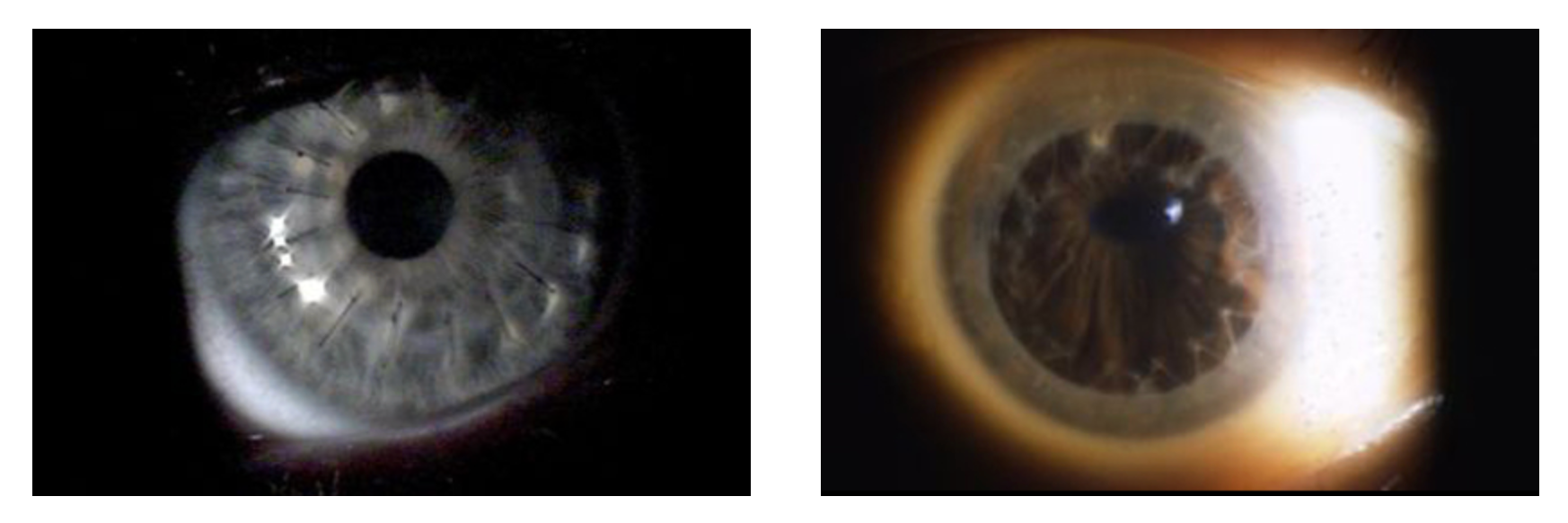
Images: Cornea transplant approximately one week after surgery. Multiple light reflections indicate folds in the cornea, which later resolved.
Long-term success & risks
As the DSEK procedure is still new, its long-term success rate compared to traditional corneal transplants is not fully known. It’s a more complex surgical procedure, and there is a risk that the surgery will need to be converted to a standard transplant, or that unusual scarring or complications occur, and a corneal transplant will still be required.
As with any procedure, potential issues can arise such as damage to the iris or colored part of the eye which could change the shape of the pupil or appearance of the iris. During surgery, damage could occur to the natural lens to either speed up or cause the development of a cataract. Have no fears though, our doctors are here to talk to you and help you through the process and you can feel confident with the skill and experience of cornea specialist John Frangie, M.D., as well as the high-tech equipment and procedures he utilizes.
Your cornea must be healthy and in good shape for your eyes to have clear vision. The cornea is the outer part of the eye that lies on the surface. It protects the eye from foreign debris and lets it focus light into the retina to discern objects.
Since the cornea is at the front and center of the eye, it also has a high risk of getting damaged, scarred, or diseased. Some risk factors for the cornea include:
- Dry eye
- Inflammation
- Allergies
- Injuries
- Cell deterioration
- Protein deposits
- Shingles
- Thinning, among other conditions
When the cornea is fully damaged, your vision becomes impacted. If glasses can’t effectively restore your sight, a cornea specialist may recommend a corneal transplant. The process entails removing all or some of the cornea. Then, the doctor replaces it with a healthy one from a donor.
Doctor John Frangie is a cornea transplant specialist in Western Massachusetts. He draws clients from all over this area and can assist you in getting the best results from the process. After assessing the condition of your cornea, Dr. Frangie will recommend the best course of action.
Services provided by Dr. Frangie
Depending on how severe your cornea problem is, a cornea specialist may recommend one of the two treatment options below:
- Full-thickness corneal transplant entails penetrating keratoplasty to replace the whole cornea. It’s necessary to wear temporary sutures after the procedure to hold the new cornea in place as healing continues.
- Partial-thickness corneal transplant: It also goes by Descemet Stripping Endothelial Keratoplasty (DSEK). The procedure doesn’t entail replacing the entire cornea but only some of the posterior or inner layers of the cornea, replacing them with healthy tissue from a donor.
Dr. Frangie uses the
DSEK approach to cornea replacement. After the procedure, sutures aren’t necessary to support the cornea. Instead, the doctor uses an air bubble to secure it within the eye.
The doctor will require you to lie on your back for some time during and after the surgery. While not everyone is a good candidate for DSEK, DR. Frangie will first discuss what to expect and prepare you for the procedure. Ensure you also ask all the questions you might have concerning the surgery and the healing process.
How successful is a DSEK corneal transplant?
Technology has played a role in improving the outcome of corneal transplants. The procedure also attracts some risk. The complications depend on the number of layers of the cornea that are affected and treated during the transplant. Some rare complications include the body rejecting the donor tissue, problems with the use of sutures, and eye infection.
Cornea transplant infection is a rare occurrence with DSEK procedures. Rejection of the transplanted tissue only occurs when the body’s system detects a foreign body and reacts unfavorably. Rejection symptoms may occur within one month after the procedure or several months later. Please seek advice from the doctor if such happens. If a cornea transplant fails, the doctor can do a repeat procedure.
Why choose Dr. Frangie for cornea transplant?
When you have a cornea problem, the first thing is to reach out to a cornea specialist for help. Looking for one can be cumbersome, given the many clinics available. Your search ends when you come to Dr. Frangie, the leading eye surgeon and ophthalmologist in the wider Western Massachusetts area.
Dr. Frangie has been practicing ophthalmology since 1992 and has extensive experience in the field. You can trust him to handle your cornea transplant procedure with care and expertise. Contact his office today to schedule a consultation.
Click Here to Get In Touch With Us
Hours:
Mon
8:30 - 5:00
Tues
8:30 - 5:00
Wed
8:30 - 5:00
Thurs
8:30 - 5:00
Fri
8:30 - 5:00
Sat/Sun
Closed
Book An Appointment
When you’re ready to take the next step towards safe and permanent vision correction, call our office at 413.363.2732 or fill out our contact form and we’ll schedule a free consultation for No Blade LASIK in West Springfield, MA.